By Adam Cortez, founder of ARC Creative Co. Research run October 21 and 29, 2026, on our own agency. The method and its limits are at the end.
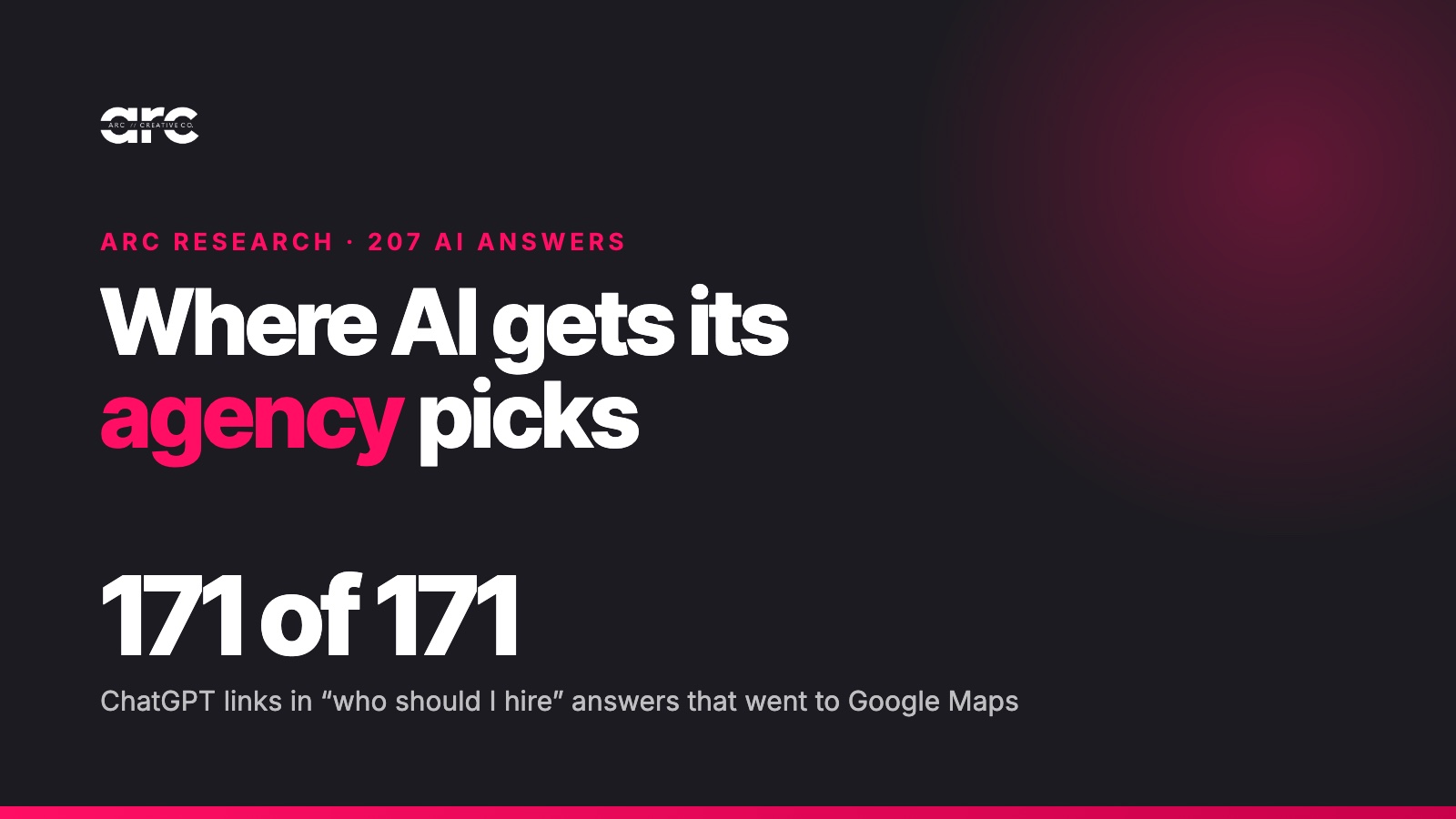
When a small business asks an AI engine who to hire, the engine mostly answers from other people’s pages: “best agencies” list articles, directories like Clutch, and, for ChatGPT, Google Maps listings. In 207 answers, 75 of 105 hiring answers cited a list article or directory, and every one of ChatGPT’s 171 links in those answers went to Google Maps. An agency’s own site got cited when the question asked for proof: our case studies were cited in 10 of 20 “show me a case study” answers, and in 0 of 28 “how do I” answers.
We sell AI search visibility, so we measured our own first. We asked ChatGPT, Claude, Gemini, Perplexity and Google’s AI Overviews the questions our prospects ask before they hire an agency like ours, three times each, and recorded every business they named and every page they cited. Here is what we found, including the parts that don’t flatter us.
1. “Who should I hire?” is answered from lists, directories and maps
Eight of our questions were hiring questions, such as “What is the best digital marketing agency in San Jose for a small business?” and “Google Ads agency that specializes in dentists”. Those 105 answers cited 817 distinct pages:
| Where the cited page lived | Citations | Share |
|---|---|---|
| A business’s own website (an agency’s homepage, service page or blog) | 400 | 49% |
| Google Maps listings | 171 | 21% |
| “Best” / “top agencies” list articles | 154 | 19% |
| Directories and marketplaces (Clutch, DesignRush, Semrush Agency Partners, Sortlist, The Manifest, Upwork and similar) | 92 | 11% |
The share hides how differently the engines behave:
- ChatGPT linked only to Google Maps: 171 of 171 links in its hiring answers. For ChatGPT, your Google Business Profile is your citation.
- Gemini cited a list article or directory in all 24 of its hiring answers, and Google AI Overviews in all 9 that returned.
- Claude and Perplexity cited one in 21 of 24 answers each.
- One list article, “best digital marketing agencies in San Jose”, was cited 28 times across Claude and Gemini, more than any agency’s own site.
If you’re not on the lists the engines read, you are mostly not in the answer, however good your website is. We weren’t: across these hiring questions, Gemini cited our site 3 times, all for one question about Google Ads management in Silicon Valley, and no other engine cited it at all.
2. A case study with numbers in the text gets cited when someone asks for proof
On October 29 we asked ChatGPT and Perplexity twelve questions our case studies answer, twice each (48 answers). Five asked for a case study outright. Our pages were cited in 10 of those 20 answers:
| Question asked | Answers citing ARC |
|---|---|
| Is there a real case study of a salon using Google Ads and Facebook ads together, with numbers? | 4 of 4, named first |
| Marketing case study of a construction company getting more leads from ads | 2 of 4 |
| Case study of a fashion brand getting high ROAS from Facebook and Instagram ads | 2 of 4 |
| Facebook ads case study for an adventure park or attraction | 2 of 4 |
| Google Ads case study for a small medical practice with cost per call | 0 of 4 |
The salon page that won every time was short when we tested it (about 600 words), but its numbers are written in the text, it names its market and dates, and it answers the exact question: what a booking cost. The medical page that lost every time had its results only inside screenshots, which an engine can’t quote. We have since rewritten it with the numbers in text, and we will re-test it in November.
3. “How do I…” questions went to help pages and software vendors, 0 of 28
The other seven questions were practical: “How do I track bookings from Google Ads when my booking software doesn’t connect to Google Analytics?”, “How much does a new patient phone call cost with Google Ads for a dentist?”. Our case studies contain those answers, yet were cited in 0 of 28 answers. The engines cited Google’s own help pages, booking-software companies and how-to blogs instead.
A case study is filed as proof, not as instructions. To be the answer to a how-to question you need a page that is a how-to, so we wrote three: tracking salon bookings, what a salon booking costs and whether Smart campaign conversions are real.
4. The engines learned our facts from data brokers, not our website
Asked “What is ARC Creative Co.?”, Claude and Perplexity said we are based in Campbell, California, in 3 of 3 runs each. Campbell is where we were founded in 2017; we are a San Jose agency. The sources were company-data sites (CB Insights, Datanyze, PrivCo) and an old LinkedIn location. Claude didn’t cite our own site once for that question. All five engines also mixed us up with similarly named businesses: a visual-effects studio, a photographer and a design firm.
The fix is unglamorous: correct the record on the sites the engines trust, and make your own pages say the same facts, in the same words, in their schema.
5. AI visitors are few, and they convert
In Google Analytics over the 90 days to October 21, the AI-assistant channel sent us 22 sessions and 2 of our 5 tracked leads and bookings, both from ChatGPT. Organic search sent 75 sessions and 1. Those are small numbers and we wouldn’t forecast from them, but both came from visitors who landed on the salon case study, the page that won in section 2.
What we’d tell any small business
- Treat your Google Business Profile as an AI asset. ChatGPT’s hiring answers linked to nothing else.
- Get onto the lists the engines read. Ask which pages they cite for your category and city, then earn a place on them: free directory profiles, real reviews, and a reason for the list’s author to include you. Paid placements must be disclosed.
- Publish proof with numbers in the text. Name the market, the dates and the result. Screenshots are evidence for people, not for engines.
- Write the how-to separately. Your case study won’t be cited for “how do I”; a how-to built from it can be.
- Fix your facts where they’re copied from. Data brokers and LinkedIn travel further than your About page.
- Measure with repeats, not one screenshot. The same question gets different answers from run to run, so ask each one several times.
How we ran it
- Dates: October 21, 2026 (12 questions × 5 engines × 3 runs = 180 requests) and October 29, 2026 (12 questions × 2 engines × 2 runs = 48).
- Engines and models: ChatGPT (gpt-4.1-mini with web search), Claude (claude-sonnet-4-5 with web search), Gemini (gemini-2.5-flash with Google Search grounding), Perplexity (sonar) and Google AI Overviews, all through their APIs. The consumer apps can answer differently.
- Returned: 207 answers. Google AI Overviews returned 15 of 36 on October 21; the rest failed with provider errors and are excluded, not counted as losses.
- What we counted: whether ARC was named, whether arccreativeco.com was cited, and every cited URL. Cited pages were grouped by domain and URL; a page cited twice in one answer counts once.
- Limits: one agency, one metro area, questions chosen by us. This shows how the engines source answers in our market, not a ranking of agencies. Total cost: about $5 in API calls.
Questions about this research
Where does ChatGPT get its local business recommendations?
In our test, ChatGPT’s answers to “who should I hire” questions linked only to Google Maps listings: 171 of 171 links. Your Google Business Profile is what it shows.
Do AI engines cite agency websites?
Mostly when the question asks for proof. Our case studies were cited in 10 of 20 “show me a case study” answers, and in 0 of 28 “how do I” answers.
How do I get my business recommended by ChatGPT and Gemini?
Be on the pages they read: your Google Business Profile, the directories and “best of” lists for your category and city, and your own pages with specific, quotable numbers. Then measure by asking each engine the same question several times.
Want to know what the AI engines say about your business? See our AI search visibility service, or book a call and we’ll run your questions with you.
Get the one-page SEO, AEO & GEO brief
How a business gets found on Google and named by AI assistants, what we measured asking the engines, and our published results, on one page.
Your one-pager is ready.
You’re on ARC’s list too, and you can unsubscribe from any email we send.