By Adam Cortez, founder of ARC Creative Co. Built from the numbers in our own client accounts, linked below.
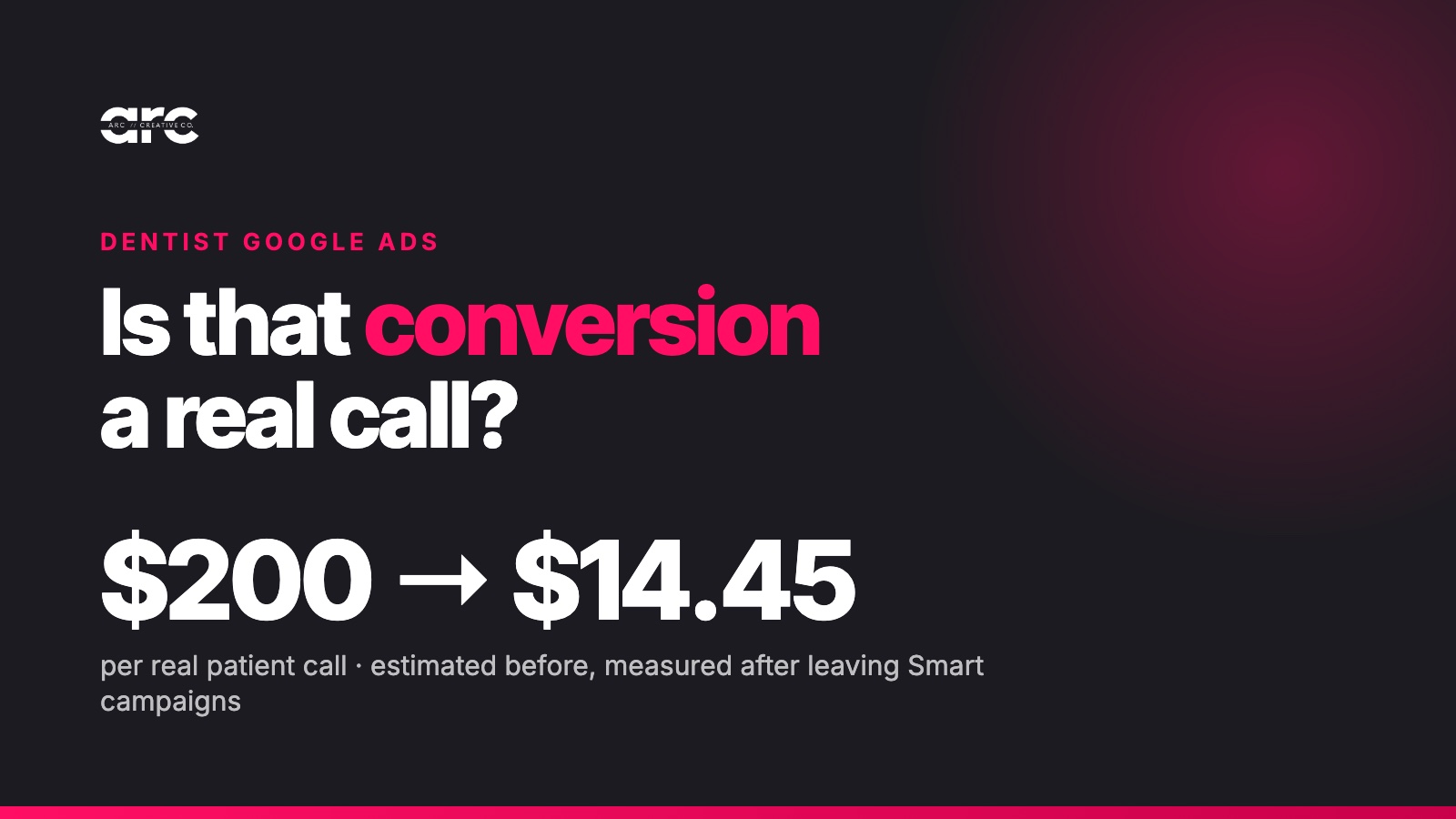
Often not. In the dental and medical accounts we’ve audited, Smart campaigns counted taps on the call button and the map as conversions, whether or not anyone called. One pediatric dentist’s Smart campaign reported 868 “call clicks” on $8,457 of spend; real calls were costing about $200 each. After we rebuilt it as a search campaign that only counts calls over 30 seconds, a real call cost $14.45.
What a Smart campaign “conversion” actually is
Smart campaigns are Google’s simplest campaign type: you give Google a budget and a few keyword themes, and it runs the rest. They are easy to start, but they report actions such as clicks on your call button and clicks for directions or on the map as results. A tap on a phone number is not a phone call, and a click on the map is not a patient.
Two practices, before and after
| Before (Smart campaign) | After (search campaigns, real calls only) | |
|---|---|---|
| Pediatric dentist | 868 “call clicks” on $8,457; about $200 per real call (our estimate) | $14.45 per call over 30 seconds; $22.13 for new patients |
| Orthopedic doctor | $43.43 per reported conversion on $11.7K; close to $100 per real call (our estimate) | $8.32 per call or form; $13.61 for new patients |
How to check your own account in 10 minutes
- In Google Ads, open Goals → Conversions and read the name of every conversion action that is counted. If you see call-button clicks, directions or map actions counted as primary conversions, your cost per conversion is not your cost per patient.
- Look for a call length setting on call conversions. No minimum means a two-second call counts.
- Compare a month of reported conversions with your front desk’s count of new-patient calls and bookings for the same month.
- Check how much of your spend goes to people searching your practice’s or doctor’s name. Those patients were already looking for you.
What to do instead
- Count calls over 30 seconds and submitted forms, and nothing else, as conversions.
- Use search campaigns with landing pages built for the treatment people searched for.
- Split branded searches from new patients. In the doctor’s account, branded calls cost $5.33 and new patients $13.61. Only the second number tells you if ads are growing the practice.
- Give it time. Both accounts started near $20 per real call and improved with weekly optimization.
Questions salon and practice owners ask
Are Google Smart campaigns good for dentists?
They are easy to start, but they can report taps on the call button and map clicks as conversions, which makes them look cheaper than they are. Measure real calls before deciding.
What should a dental practice count as a Google Ads conversion?
Phone calls longer than about 30 seconds and submitted appointment forms. Not call-button taps or map clicks on their own.
How much does a real patient call cost on Google Ads?
In our accounts, $14.45 per call for a pediatric dentist and $8.32 per call or form for an orthopedic doctor, with new-patient calls at $22.13 and $13.61. Your market will differ.
Want to know what your practice really pays per call? See how we run Google Ads for dentists or book a call.
Get the one-page Google Ads brief
How ARC runs Google Ads, what we fix first in an inherited account, and the results we’ve published, on one page you can keep or pass on.
Your one-pager is ready.
You’re on ARC’s list too, and you can unsubscribe from any email we send.